
on Google
Breast Surgery · Barcelona
Gynecomastia in Barcelona
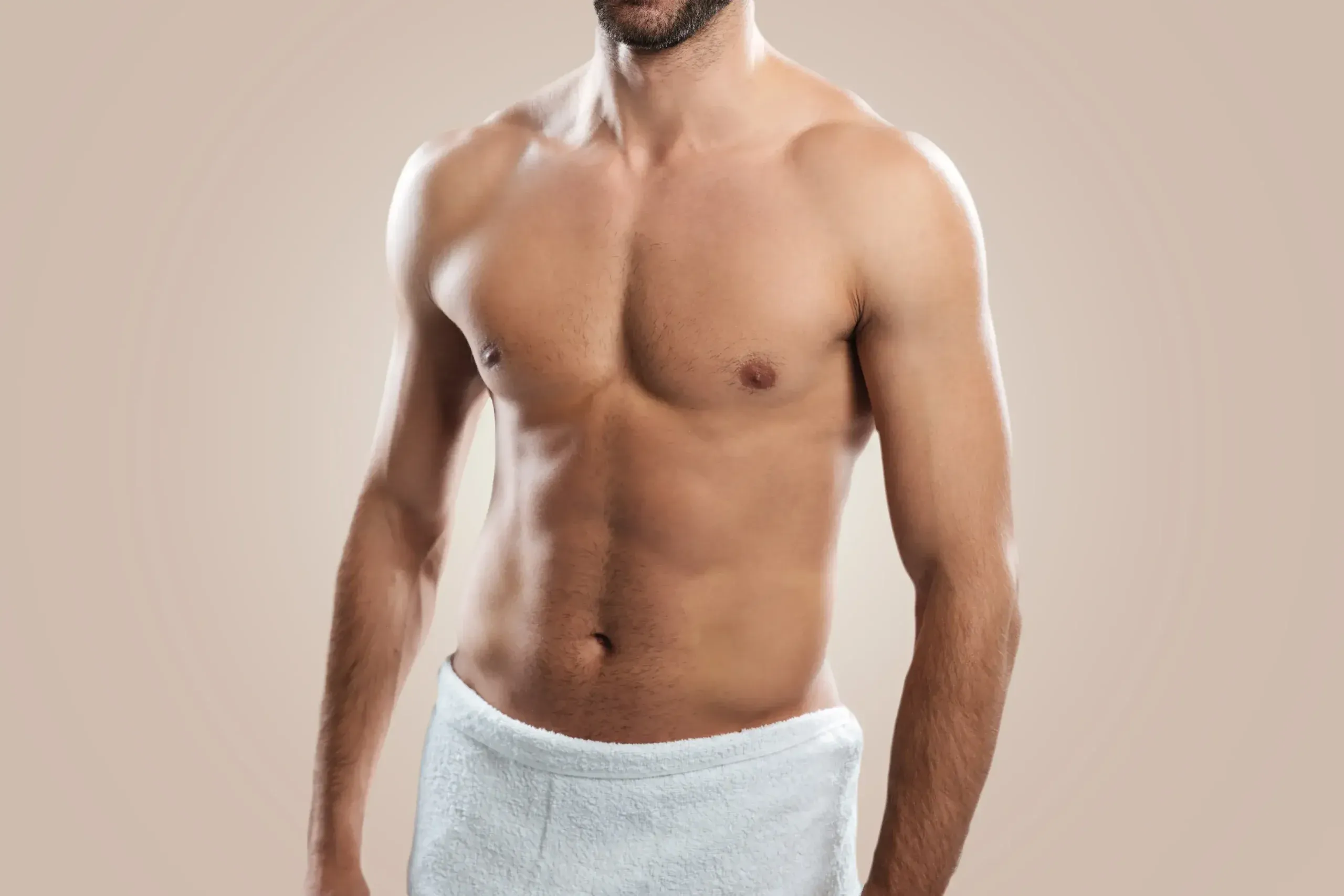
Gynecomastia in Barcelona is corrected with surgery when an enlarged male breast has been like that for some time, causes discomfort and does not go down with other measures: the glandular tissue is removed and, if there is any, the excess fat. At Clínica EGOS we hold consultations for gynecomastia in Barcelona at Balmes, Aribau, Guinardó, Madrazo and Poblenou.
Updated
On this page
- How do we tell glandular tissue, fat and pseudogynecomastia apart at the consultation?
- Can gynecomastia hide another health problem?
- Why does gynecomastia in an adult not go away on its own like the one in puberty?
- Does it matter if you have taken anabolic steroids or gym supplements?
- What changes depending on the grade of gynecomastia?
- What happens at the first gynecomastia consultation in Barcelona and what do we give you in writing?
- Gynecomastia in Barcelona: how the operation works at EGOS and the timelines we give
- Can I show my torso on the Barcelona beach with the scar?
- Gynecomastia in Barcelona: the clinics, their neighbourhood and where to park
- Gynecomastia near Barcelona: the other EGOS clinics in Catalonia and Andorra
- Other treatments in Barcelona
This page is for adult men and covers what is not usually told: how we tell glandular tissue from fat at the examination, what other causes are ruled out before operating, why the plan changes depending on when the breast enlargement started, what we give you in writing and where each clinic is, with its neighbourhood and the nearby public car parks. The operation and the recovery by stages are in our gynecomastia surgery guide.
How do we tell glandular tissue, fat and pseudogynecomastia apart at the consultation?
Two breasts that look the same from the outside can be made of different things, and the operation depends on that. At the gynecomastia consultation in Barcelona we separate three situations. In glandular gynecomastia the mammary gland grows: the tissue feels firm and dense around the nipple, and it usually goes with a hormonal imbalance. In pseudogynecomastia there is no extra gland, only fat accumulated in the chest area, and the breast is soft to the touch. The mixed type, which combines both, is the most common.
The examination is the first filter, and the medical literature describes it in detail. First the patient is observed sitting; then, lying down, the doctor palpates the breast with flat fingers and brings the thumb and index finger together from both sides. In true gynecomastia a disc of firm tissue is felt, concentrated around the nipple; in pseudogynecomastia that resistance does not appear (Barros and Sampaio, 2012). That same review points out that a hard, irregular lump, in one breast only and outside the areola, is not gynecomastia and is investigated by another route.
When the hand is not enough, at EGOS we request, if needed, a breast ultrasound scan or blood tests. A 2021 review on imaging in gynecomastia (Billa, Kanakis and Goulis) explains that most lesions of the male breast are diagnosed by examination and that imaging helps when the examination is not conclusive. On the ultrasound scan of a recent gynecomastia, a dark disc-shaped area is seen under the areola; over the months, as the tissue becomes fibrous, that area looks brighter. If fat predominates, the route starts with weight, as we explain in the guide on chest fat in men, and, if needed, continues with liposuction; the gland, by contrast, does not go down with training.
Can gynecomastia hide another health problem?
It is almost always benign: it does not usually pose a serious health risk, although it sometimes hurts and almost always weighs on the mood. But in an adult it is worth looking beyond the breast. The clinical guidelines of the European Academy of Andrology (Kanakis and colleagues, 2019) point out that, when an adult man is investigated in depth, an underlying cause appears around half of the time.
The causes that are looked for are few and specific: medicines, substances, liver, kidney or thyroid diseases and hormonal imbalances. A review published in the Indian Journal of Endocrinology and Metabolism (Cuhaci and colleagues, 2014) notes that medicines explain up to a quarter of cases and that alcohol disrupts the hormonal axis that regulates testosterone.
According to the European guideline, the work-up of an adult includes: when the breast enlargement started and how long it has been like that; which medicines and substances are taken; examination of the breast and also of the testicles, because some testicular tumours produce hormones and palpation alone detects them poorly; and, as an option, tests for testosterone, estradiol, the hormones that govern the testicles, the thyroid, prolactin and liver and kidney function. If any of this comes back abnormal, the first step is to treat it and the operation waits.
And some reassurance: breast cancer in men is rare and gynecomastia is not considered a lesion that heralds it. Even so, a lump in the breast or nipple, discharge from the nipple or changes in the skin should be discussed with your GP, as the NHS advises.
How long have you had it?
It is the question that weighs most in the plan. The Cuhaci review describes two stages of the tissue: in the first months, up to about six, there is proliferation and inflammation, and that is when it tends to hurt or be tender; after roughly a year, the gland has filled with fibrosis, it hurts less and no longer responds in the same way to medical treatment. The European guideline advises watchful waiting just after treating the cause or stopping the substance, and reserves surgery for long-standing gynecomastia that does not recede on its own or with medical treatment.
In practice, at the consultation: tell us since when you have noticed it, whether it has got bigger and whether it hurts. If it started a few weeks ago, the prudent thing is to wait and review it; if it has been there for years, the conversation is different.
Why does gynecomastia in an adult not go away on its own like the one in puberty?
Because they are two different situations, and this gynecomastia in Barcelona page is about the adult one. The one in puberty is common: according to the European guideline, it affects half of boys at the midpoint of that stage and in more than nine out of ten cases it resolves on its own within two years. That is why at that age we wait and monitor, and at EGOS we recommend surgery from the age of 18, when physical and hormonal development has finished.
If you are 25, 35 or 45 and your breasts are still as they were in adolescence, it is not a phase that will pass: it is persistent gynecomastia, and everything above applies: causes, time and tests.
And what if the breast grows after 50?
It is another of the moments when the male breast can grow. The Cuhaci review places gynecomastia in men between 50 and 80 years old at between 24 and 65% and attributes it mainly to the fact that with age fat increases, which turns androgens into oestrogens, testosterone falls and more medicines are taken.
That is why, at that age, the first thing we check is the medicines you take every day.
Does it matter if you have taken anabolic steroids or gym supplements?
It does matter, and that is why we ask without judging. Anabolic steroids are among the known causes of gynecomastia and they are not rare in the consultation: in a series of 964 operations by the same surgeon, 11% of the patients had used them (Vojvodic and colleagues, 2019). For us it is a planning detail, not a reproach. If the substance is still being taken, it is first stopped and then we wait, as we explained above; if it was already stopped, the surgeon takes it into account when planning how to remove the gland. Tell us everything, including gym products whose composition you do not know.
What changes depending on the grade of gynecomastia?
In surgery four grades are spoken of, which depend on how much the breast has grown and on the height of the nipple in relation to the inframammary fold. This is how Barros and Sampaio describe them: grade I is an enlargement limited to the areola; II, a moderate growth of the whole breast with the nipple still above the fold; III, a large breast in which the gland sags and the nipple reaches the level of the fold, or up to one centimetre below; and IV, a large breast with excess skin and the nipple more than one centimetre below.
The skin matters more than it seems. The same review holds that skin sagging and excess skin are what most guides the choice between techniques.
And there is a factor that is almost never mentioned: build. An Italian group that operated on 312 adult men divided them into three: muscular with very little fat, of normal build and overweight. Its authors conclude that the same problem is handled differently depending on build and on what each person expects from the operation (Innocenti and colleagues, 2017). The practical consequence: come to the consultation knowing what you want to see in the mirror.
What happens at the first gynecomastia consultation in Barcelona and what do we give you in writing?
To make the assessment worthwhile, bring three things with you. A list of what you take, including supplements and gym products, because that review is the one the ASPS includes in any gynecomastia consultation. Any tests you have had, if you have had them: blood tests or ultrasound scans. And a photo from when the breast enlargement started, if you have one, because the surgeon asks about timing and progression.
What we give you in writing
There are two things we always give you in writing. One is the quote, written and itemised, which is only given once we have examined you, because until then there is no figure that holds. The other is who operates on you and where. Before you book a date, we tell you in writing who will operate on you, with their registration number with the medical association, and at which centre, with its health registration number.
Gynecomastia in Barcelona: how the operation works at EGOS and the timelines we give
At EGOS gynecomastia is operated under general anaesthesia and takes between one and two hours, depending on complexity. The incision sites are marked and small cuts are made around the areola or in the armpits; through them the gland is removed and the excess fat is taken out with liposuction. If there is excess skin, it is removed as well. The incisions are closed with fine stitches and a bandage is applied. According to the SECPRE, it is usually done without an overnight stay; if in your case it is advisable to stay the night, we tell you before setting the date.
The timelines we give are these: one week of initial recovery, return to everyday activities in one or two weeks and intense exercise not before one month. What happens day by day, with the stitches, the compression garment and the check-ups, is in the recovery guide, with the sources for each timeline.
Can I show my torso on the Barcelona beach with the scar?
With gynecomastia in Barcelona there is a calculation to make early: the scar is usually around the areola, in the middle of the chest, and it is the first thing to catch the sun when you take your shirt off at the beach. The SECPRE asks for scars to be protected from sunlight for at least six months, because they can darken. Do the calculation with the calendar in hand: operated in October, the six months end in April and you reach summer without that precaution; operated in March, almost the whole summer falls within those six months and you need to cover the area or use the sunscreen the team tells you. That is why it is worth choosing the date at the consultation with your holidays in mind.
Gynecomastia in Barcelona: the clinics, their neighbourhood and where to park
The switchboard (+34 932 71 80 69) and the address info@clinicaegos.com work for any of the five; when you book you can say which suits you best. If you come by car, these are nearby public car parks listed in the Ajuntament de Barcelona inventory, measured in a straight line; confirm spaces and opening hours with each car park, because most of their municipal listings date from 2023. The distances to the plaça de Catalunya, which serves as a common reference, are also in a straight line.
Balmes and Madrazo, 240 metres apart in Galvany
Our cosmetic surgery clinic in Barcelona, the Balmes one, has its door at number 268 Carrer de Balmes, and the Madrazo clinic is at Carrer dels Madrazo, 60-66, 240 metres away: both in the Sant Gervasi-Galvany neighbourhood (Sarrià-Sant Gervasi district), about 2.4 km from the plaça de Catalunya. Each has a car park about 110 metres away: for Balmes, the one at Carrer dels Madrazo, 27; for Madrazo, the one at number 46 of that street (Monday to Friday, from 8 to 22 hours, according to the inventory). The one at Carrer de Laforja, 30, about 200 metres from both, is listed as open every day, day and night.
Aribau, in l'Antiga Esquerra de l'Eixample
The Aribau clinic is at Carrer d'Aribau, 192, and is the closest to the centre: about 1.6 km from the plaça de Catalunya. The car parks at Carrer de París, 184, about 80 metres away, and at Carrer d'Aribau, 168, about 120, appear open twenty-four hours.
Guinardó, in the Camp d'en Grassot i Gràcia Nova
The Guinardó clinic bears the name of the Guinardó, although its street, Carrer de Sardenya, 515, is according to the street map in the Camp d'en Grassot i Gràcia Nova neighbourhood, about 2.7 km from the plaça de Catalunya. Nearby are the car park at Carrer de Pau Alsina, 80, about 100 metres away, and the one at Carrer de la Legalitat, 60, about 220, both open twenty-four hours according to the inventory.
Poblenou, next to the Rambla del Poblenou
The Poblenou clinic is at Avinguda Diagonal, 141, in Poblenou (Sant Martí district), about 3.2 km from the plaça de Catalunya: it is the furthest from the centre. The car park at Carrer de Sant Joan de Malta, 181, about 120 metres away, opens Monday to Friday, from 7:30 to 23:00 hours, and about 210 metres away there is another on the Rambla del Poblenou, 130.
How the five are spread out
Three of the five, Balmes, Madrazo and Aribau, are less than one kilometre from each other. Guinardó is about 1.7 km from Balmes and 2.1 from Aribau, and Poblenou is more than 4 km from Balmes and Madrazo. When you book, ask whether the check-ups are at the same clinic as the first consultation, so you know from the start what your journey will be.
Gynecomastia near Barcelona: the other EGOS clinics in Catalonia and Andorra
If you live in the metropolitan area or in the surrounding districts, you may have one of our clinics closer: we also hold gynecomastia consultations in L'Hospitalet, Cornellà, Badalona, Sabadell, Terrassa, Mataró and Granollers, and outside the area, in Girona, Tarragona, Reus, Lleida, Manresa, Vilanova i la Geltrú and Andorra. The five Barcelona clinics are the ones most within reach if you live or work in the city.
Other treatments in Barcelona
In Barcelona we also hold consultations for: Abdominoplasty in Barcelona, Buttock augmentation in Barcelona, Breast augmentation in Barcelona, Hair transplant in Barcelona, Facelift in Barcelona, Liposuction in Barcelona, Tuberous breasts in Barcelona, Mastopexy in Barcelona, Otoplasty in Barcelona and Rhinoplasty in Barcelona.
Sources for this page
To write this page we have read the Clínica EGOS gynecomastia page; the clinical guidelines of the European Academy of Andrology (Kanakis and colleagues, 2019); the reviews by Barros and Sampaio (2012), by Cuhaci and colleagues (2014) and by Billa, Kanakis and Goulis on imaging (2021); the studies by Innocenti and colleagues (2017) and by Vojvodic and colleagues (2019); the ASPS gynecomastia consultation page; the SECPRE section on the breast; the NHS page on gynaecomastia; Royal Decree 1030/2006; the Ajuntament de Barcelona car park inventory and OpenStreetMap for the neighbourhoods and the straight-line distances. Everything was consulted in October 2026.
Content reviewed by Dr. Santiago Elvira i Barberà, plastic surgeon (Medical Association member no. 49756) · October 2026
For information only; it does not replace a consultation with a healthcare professional. The results of any procedure depend on each patient and are assessed individually. Clínica EGOS.
Where we treat you
Clínica EGOS Barcelona Guinardó
Carrer de Sardenya, 515, 08024 Barcelona
Clínica EGOS Barcelona Madrazo
Carrer dels Madrazo, 60-66, Sarrià-Sant Gervasi, 08006 Barcelona
Clínica EGOS Barcelona Poblenou
Av. Diagonal, 141, Sant Martí, 08018 Barcelona
Frequently asked questions
At which clinic do you treat gynecomastia in Barcelona?
At any of the five: Balmes, Aribau, Guinardó, Madrazo and Poblenou. When you book, by phone or with the form, tell us which suits you best and we will confirm where we expect you.
Is there parking at the Barcelona clinics?
Near each one there are public car parks; in the section on the clinics you have the distance and opening hours of the closest ones. Confirm spaces and opening hours with the car park before you come.
Which doctor treats gynecomastia: the GP, the endocrinologist or the plastic surgeon?
It depends on the stage. The European guideline suggests that initial screening is done by the GP, that the in-depth work-up is done by a specialist and that surgery is considered for long-standing gynecomastia. At EGOS a specialist doctor assesses you; if something turns up that is not a matter for surgery, we tell you so that the appropriate doctor sees you first.
Does gynecomastia go away on its own?
The one in puberty almost always does, within a couple of years. In an adult it depends on the cause: if it is a medicine, a substance or an illness, treating it can make it go down. When it has been there for years and there is excess glandular tissue, it does not go down with exercise or diet and the correction is surgical. At EGOS surgery is indicated from the age of 18, in men who want to correct the enlargement and are in good general health.
What anaesthesia is used and how long does the operation take?
General anaesthesia: it is the one we use in this operation. It takes between one and two hours, depending on the complexity of each case.
When can I go back to the gym?
To intense exercise, not before one month; your surgeon tells you when at the check-up. Everyday activities are resumed earlier, in one or two weeks.
How much does gynecomastia cost in Barcelona?
Each breast calls for a different operation, so the figure comes after examining you, in a written, itemised quote that covers the technique, the anaesthesia, the possible liposuction and the check-ups.
Does public healthcare cover it?
It depends on the cause: Royal Decree 1030/2006 excludes anything with a purely aesthetic purpose, unless it responds to an illness, an accident or a congenital malformation. If you think your case is different, start with your GP.
No obligation
Book your appointment and take the first step
Book a personalised assessment with our team of surgeons. We answer all your questions and design a plan tailored to you, with full transparency.