
In this article
- How much does a hair transplant cost?
- Hair transplant cost: what does it depend on?
- Hair transplant cost: what should the quote include?
- Why does the cost of a hair transplant vary so much between clinics?
- How can you compare clinics without looking only at price?
- Who is a good candidate for a transplant and how does it affect the quote?
- Hair transplant cost: is it covered by the Spanish public health system?
- When are the results visible?
- Sources
- Frequently asked questions
Hair transplant cost: the honest answer is that there is no single fee, because it depends on how many follicles your scalp needs, the technique and what the treatment includes. That is why the quote is given in writing and itemised after the assessment. Below we go through what the cost depends on and how to compare quotes sensibly.
How much does a hair transplant cost?
It depends on your case, and any price that does not start from an assessment is a blind estimate. Two people with the same degree of baldness may need different numbers of follicles if their hair is finer or thicker, or if they want a different density.
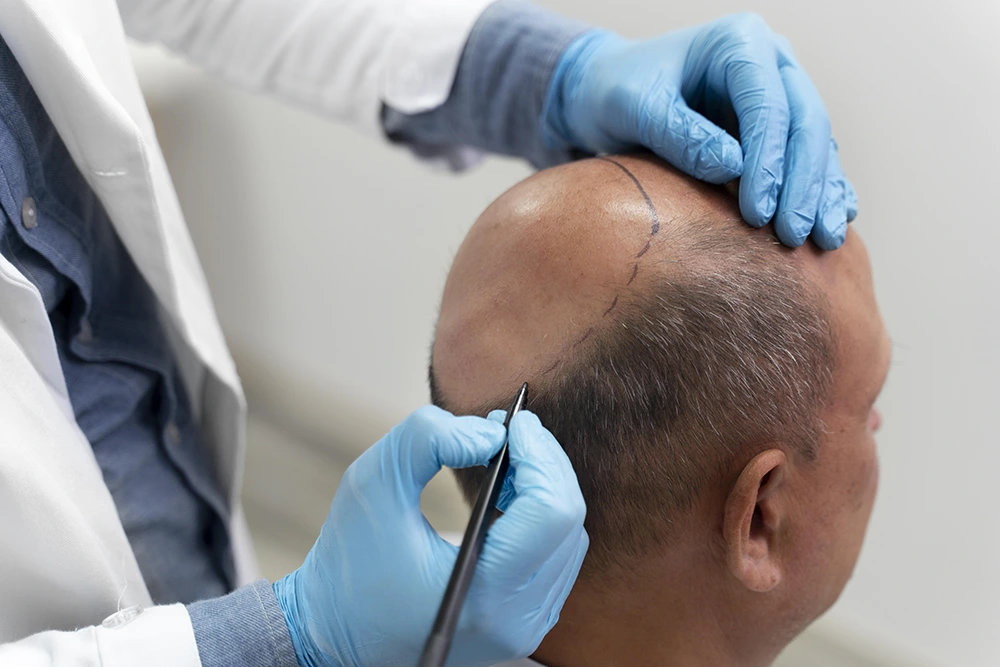
What we can tell you is how the price is built up. According to the StatPearls review updated in 2025, modern hair transplantation involves extracting follicular units from the occipital area of the scalp and moving them to the areas with hair loss. Anything that changes the team’s workload (a larger area, more follicles, more time in theatre) changes the quote.
After the consultation you receive the breakdown in a document. If you would like to see what the procedure involves before deciding, you will find all the information on our hair transplant page.
Hair transplant cost: what does it depend on?
These are the factors that matter most, from greatest to least.
The number of follicles and the size of the area
This is the main factor. Covering a receding hairline does not cost the same as covering a large bald area or the crown, because the number of follicular units to be extracted and implanted is different. According to our hair transplant page, the sapphire FUE technique can transplant up to 3,500 follicular units in cases of advanced alopecia, and DHI FUE up to 2,500 in smaller cases or to improve density.
The technique chosen
Our hair transplant page describes two techniques, and the surgeon recommends one or the other depending on your case:
- Sapphire FUE: makes incisions with sapphire blades and is indicated for covering large areas. It leaves small scabs, which fall off 7 to 10 days later.
- DHI FUE: implants the follicles directly, without prior incisions, and is considered for improving density where there is already hair. It does not form scabs.
The choice depends on what you need, not on which one is “best” in the abstract. Each technique involves different time and work, and that is reflected in the quote.
The quality of the donor area and the type of alopecia
The transplanted hair comes from your own scalp, so how much is available and its condition matter. A donor area with good density allows planning with some margin; if it is limited, the plan changes and that may affect the cost. Stable androgenetic alopecia is the classic candidate, whereas active hair loss is best stabilised first. If you are unsure whether yours is temporary hair loss, read our article on hair loss due to stress.
The number of sessions
According to our page, one session is usually enough for small areas of alopecia, while larger ones may need two to three, with the interval set by the patient. If your plan involves several sessions, the quote includes this from the outset.
Length of the procedure and resources involved
The operation is performed under local anaesthetic and lasts between five and seven hours, according to the information on our website. It is lengthy work that occupies a medical team for several hours, and that time forms part of the cost.
Complementary treatments and follow-up
Some people combine the transplant with supporting treatments, such as platelet-rich plasma (PRP), which can be assessed in consultation. Follow-up appointments and any medication the doctor prescribes should also appear in the quote.
Hair transplant cost: what should the quote include?
Always ask for the quote in writing and check that it sets out, at a minimum:
- The initial assessment and the treatment plan.
- The proposed technique and the estimated number of follicular units.
- The full procedure, with the appropriate anaesthesia.
- Medication and post-operative care.
- Follow-up appointments.
- What is not included, if anything, and when each part is paid.
A clear quote lets you compare the cost of a hair transplant between clinics fairly. One that just says “hair transplant” with no detail is no use for comparison.
Why does the cost of a hair transplant vary so much between clinics?
Because you are rarely comparing like with like. One clinic may quote for one number of grafts and another for a very different number for the same scalp. One may include follow-up appointments and medication while another charges for them separately. And it is worth knowing whether the assessment is carried out by a doctor.
That is why it pays to look at what the quote contains before its total. A lower quote may mean fewer grafts, less follow-up or a shorter procedure, and you will only know if you ask.
How can you compare clinics without looking only at price?
Comparing the cost of a hair transplant at two clinics only makes sense if the plan is the same. Before deciding, it is worth asking:
- Who carries out the assessment. The diagnosis should be made by a registered doctor.
- How many grafts are proposed and why that number, not just the total cost.
- Which technique is used and why it is right for you.
- What happens afterwards: follow-up appointments, and who you call if you have questions.
- What result is realistic in your case, without firm promises.
The UK’s National Health Service points out in its information on hair loss that no treatment is 100% effective, and advises that a doctor first assesses the cause of the hair loss. The same caution applies to a transplant: be wary of anyone who guarantees the same result for everyone.
If your case does not require surgery, see our page on hair restoration treatments.
Who is a good candidate for a transplant and how does it affect the quote?
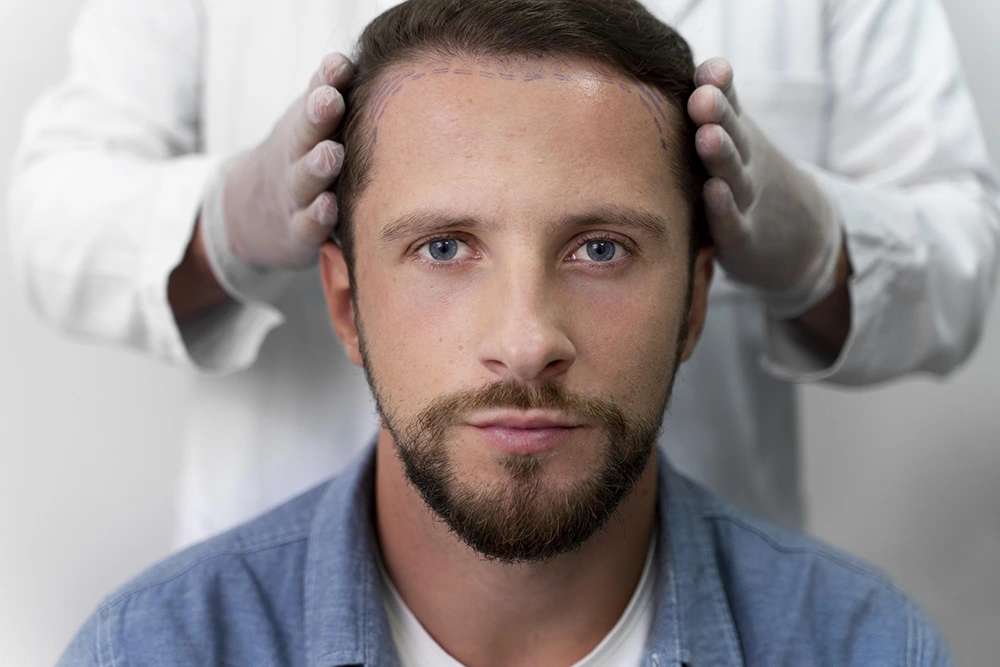
Not everyone who asks about the price is a candidate, and that is decided before money is discussed. According to the StatPearls review updated in 2025, the best candidates have a clear, stable pattern of hair loss, with at least 50% thinning or baldness in one or more areas, a healthy scalp and a donor area with good-quality hair in sufficient quantity.
The same review places the safe donor zone between the occipital protuberances, with around 65 to 85 follicular units per square centimetre: above 80 it considers it excellent and below 40 less suitable. And since this hair is limited, the same review advises against using up the donor area grafts too early.
Translated into your quote: the more area you want to cover and the less hair there is available to move, the more limited the plan becomes. That is why a serious quote starts from an assessment of your donor area, not from a price per graft.
Hair transplant cost: is it covered by the Spanish public health system?
Generally, no. The public health system funds the services listed in Royal Decree 1030/2006, and its Annex III excludes cosmetic operations when nothing links them to an accident, an illness or a congenital malformation.
If your case stems from an accident or an illness, it is a different situation that your doctor and the public health system will assess. If not, the transplant is usually treated as a private procedure. As for private medical insurance, it depends on each policy: ask your insurer and check the exclusions before deciding.
When are the results visible?
Here time matters as much as money. According to the information on the EGOS hair transplant page, transplanted hair starts to show at around three months, and the final result is usually seen from six months up to a year. Anyone promising results in weeks is promising something hair does not do. New hair takes months to show, and it is worth knowing this before comparing quotes; Carlos’s experience with his hair transplant describes what that timeline was like.
Hair surgery also carries risks, and the surgeon should go through them with you in person so you can decide calmly.
Sources
- Goldin J. et al. Hair Transplantation. StatPearls, 2025
- NHS · Hair loss
- BOE · Real Decreto 1030/2006 (Annex III, specialised care)
Content reviewed by Dr. Santiago Elvira i Barberà, plastic surgeon, registration no. 49756 · October 2026
Frequently asked questions
- How much does a hair transplant cost?
- Hair transplant cost: is there a fixed fee?
- How many follicles are needed?
- Does a hair transplant leave scars?
- Can women have a hair transplant?
- When will I see the final result?
It depends on the number of follicular units you need, the technique and the planned sessions. That is why it is calculated after an assessment and provided in writing and itemised.
No. No two scalps are the same: the extent of baldness, the density you want and the donor area change each patient’s plan.
It varies a great deal. According to the information on our website, the sapphire FUE technique allows up to 3,500 follicular units and DHI FUE up to 2,500. The surgeon estimates the exact number in consultation.
According to our page, the FUE technique leaves hardly any visible marks. The FUT technique, which removes a strip of skin, can leave a linear scar that is usually hidden under the hair.
According to StatPearls (2025), androgenetic alopecia, in both men and women, is the most common indication for a transplant. What decides whether you are a candidate is the initial assessment: the hair loss pattern must be stable and there must be enough donor area.
The first hairs appear at around three months, and the full result arrives from six months up to a year.